|
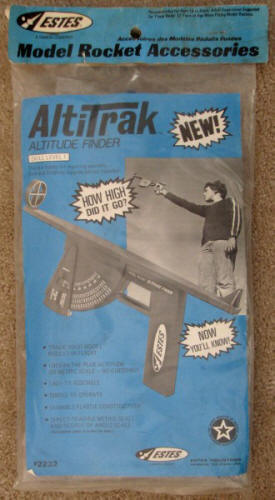
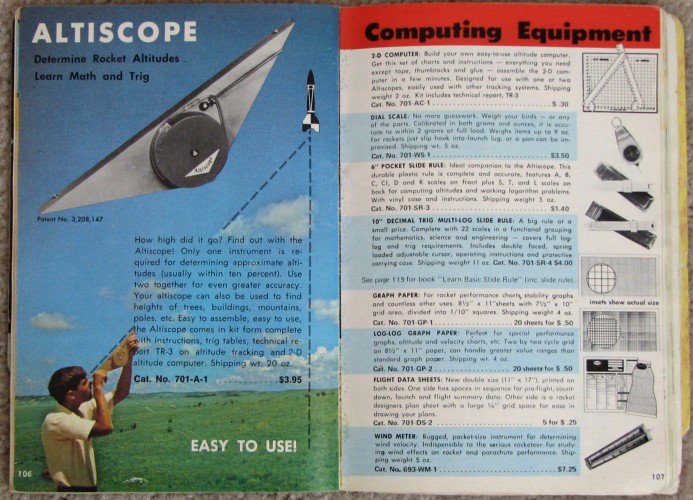
  Here are the vintage Estes Altiscope
(left) and AltiTrak (right). The
one I had back in the 1970s was the wooden Altiscope. It used a plastic tube
filled with kerosene as a level indicator. The AltiTrak one is a newer incarnation made of plastic and is held like
a pistol. It uses a weighted plumb bob as an indicator. Here are the vintage Estes Altiscope
(left) and AltiTrak (right). The
one I had back in the 1970s was the wooden Altiscope. It used a plastic tube
filled with kerosene as a level indicator. The AltiTrak one is a newer incarnation made of plastic and is held like
a pistol. It uses a weighted plumb bob as an indicator.
Both models work on the right triangle completion principle. You stand off a
predetermined distance from where you expect the rocket to be at apogee (its high
point of flight), and then follow it up with your instrument. At the highest point,
you lock the angle indicator on the protractor. You can see the concept in the picture
to the left (click for a larger version).
The base of the right angle angle is the side adjacent to the measured angle
(θ), which makes the vertical line to the apogee the side opposite the measured
angle. Since the tangent of an angle is equal to the quotient of the side opposite
divided by the side adjacent (which you determined at the beginning), that leaves
the altitude being:
Altitude = Base * tan (θ)
 When I was a teenager
trying to use my Altiscope, I didn't know a tangent from a schmangent. Fortunately,
Estes provided a table of values. Yes, teachers had attempted to learn me about
trigonometry, but I wasn't having any of it. As they did with many other rocket-related
topics, Estes produced a very nice When I was a teenager
trying to use my Altiscope, I didn't know a tangent from a schmangent. Fortunately,
Estes provided a table of values. Yes, teachers had attempted to learn me about
trigonometry, but I wasn't having any of it. As they did with many other rocket-related
topics, Estes produced a very nice  pamphlet entitled "Estes Industries
Technical Report TR−3, Altitude Tracking," Cat. No. 651−TR−3. NASA has a do-it-yourself
Altitude Tracker plan for building a simpler type of height
measuring device (here
it is on
Archive.org in case NASA disappears due to being too White for
them these days). pamphlet entitled "Estes Industries
Technical Report TR−3, Altitude Tracking," Cat. No. 651−TR−3. NASA has a do-it-yourself
Altitude Tracker plan for building a simpler type of height
measuring device (here
it is on
Archive.org in case NASA disappears due to being too White for
them these days).

Estes Altiscope Kit (Cat. No. 651−A−1)
Here is a list of my other rocket models.
Posted March 20, 2023
(updated from original post on 5/15/2011)
|